选择语言

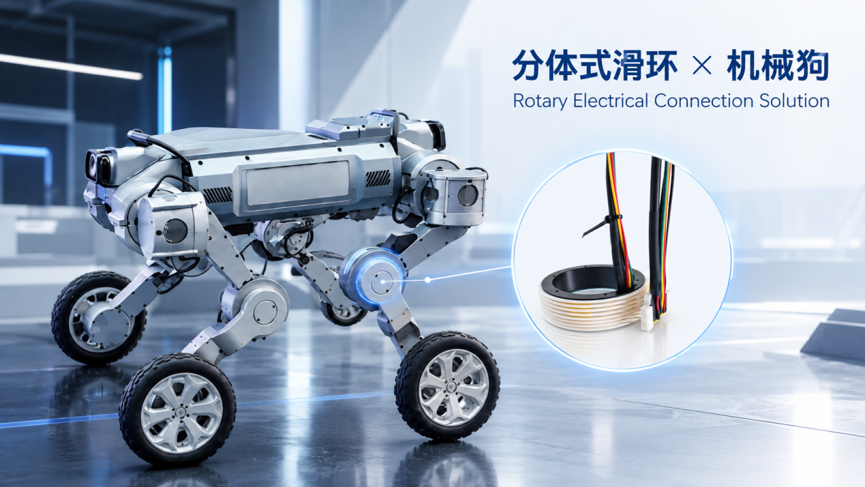
Quadruped robots require electrical power and signal transmission between stationary and rotating components while their leg joints move during walking, turning, climbing, and obstacle navigation. In joints with continuous rotation requirements, conventional cables may experience repeated bending or twisting, making cable routing more complicated.
A split slip ring can be considered for rotary electrical transmission when the joint structure, available installation space, and electrical requirements are compatible with the product configuration.
1. Quadruped Robot Applications and Transmission Requirements
Different quadruped robot joint structures may have different rotary transmission requirements.
Leg Joints and Rotary Mechanisms: Leg joints may contain motors, reduction mechanisms, encoders, and other components. Electrical connections need to be arranged according to the joint's movement and mechanical layout.
Power and Signal Transmission: Depending on the equipment design, the rotating joint may require electrical power, control signals, or data transmission between stationary and rotating parts. The required circuit configuration and signal types should be evaluated according to the actual application.
Compact Joint Structures: The space available for a slip ring may be limited by motors, reduction mechanisms, and other components. Installation dimensions, mounting positions, and cable routing therefore need to be considered during product selection.
The specific transmission requirements depend on the robot's joint design and operating conditions.
2. Key Selection Criteria for Quadruped Robot Split Slip Rings
When evaluating a split slip ring for a quadruped robot, the following criteria should be considered:
Evaluation Dimension |
Selection Focus / Criteria |
Installation Space |
Limited or irregular space inside the joint; available mounting position |
Mounting Requirements |
Relationship between stationary and rotating parts; fixing method |
Transmission Requirements |
Power, control signals, and data transmission needs |
Rotation Conditions |
Continuous rotation or oscillating movement; operating speed |
Cable Routing |
Cable entry and exit directions; surrounding mechanical components |
The suitability of a split slip ring should be determined through an evaluation of the actual equipment structure and transmission requirements.
A product should not be selected solely because it is described as suitable for robots or quadruped robots. Mechanical integration and electrical requirements must also be considered.
3. HISCIENCE Split Slip Ring Solutions for Quadruped Robots
HISCIENCE provides slip ring products and customized rotary transmission solutions for different equipment applications.
For quadruped robot joints, the solution evaluation may focus on the following aspects:
Structural Adaptation: Evaluate the available installation space, structural dimensions, and mounting arrangement in relation to the existing joint mechanism.
Electrical Configuration: Determine the required power and signal circuits according to the equipment's electrical and data transmission requirements.
Mounting and Cable Routing: Evaluate the installation method, cable exit direction, and wiring arrangement according to the mechanical layout.
The specific product series and configuration should be selected based on the actual application requirements and confirmed technical specifications.
For more information, visit the HISCIENCE Separated Slip Ring Product Center
4. Information Required Before Requesting a Solution or Quotation
To help the HISCIENCE engineering team evaluate a suitable slip ring configuration, customers are encouraged to prepare the following information before making an inquiry:
(1) Mechanical Parameters: Available space (OD/length constraints), through-bore diameter, mounting style.
(2) Electrical & Signal Requirements: Number of circuits, rated current/voltage, signal types (e.g., RS485, EtherCAT, HD-video).
(3) Rotational Conditions: Rotational speed (RPM), direction, continuous vs. intermittent rotation.
(4) Operating Environment: Operating temperature range, IP rating requirements (IP54/IP65/IP68), dust/moisture/vibration levels.
(5) Special Requirements: Integration of encoders, pneumatic channels, hydraulics, or fiber optic joints.
(6) Application Information: Quadruped robot model or joint application, operating conditions, and equipment photographs if available
For applications involving quadruped robots and other rotating equipment, customers can provide equipment drawings, installation dimensions, and electrical requirements to Huasheng Electric for further technical assessment, please Contact Hiscience Team.
Sales Team:
Tel:+86-13543318795
+86-0755-23200548
+85-263174136
Email:sales@hslipring.com
WhatsApp:+8613543318795
WeChat:13543318795
Address:3rd Floor, Building 1, Hengchangrong High-tech Industrial Park, No.128 Shangnan East Road, Shajing Subdistrict, Bao'an District, Shenzhen City