选择语言

To accurately describe a space-constrained rotary application for slip ring evaluation, engineers must clearly define the physical boundary dimensions (axial height, radial outer diameter, and optional inner bore) alongside essential electrical and environmental requirements. Providing precise dimensional envelopes, mounting interfaces, and circuit parameters enables slip ring manufacturers to determine whether a standard low-profile unit or a custom-integrated solution is required.
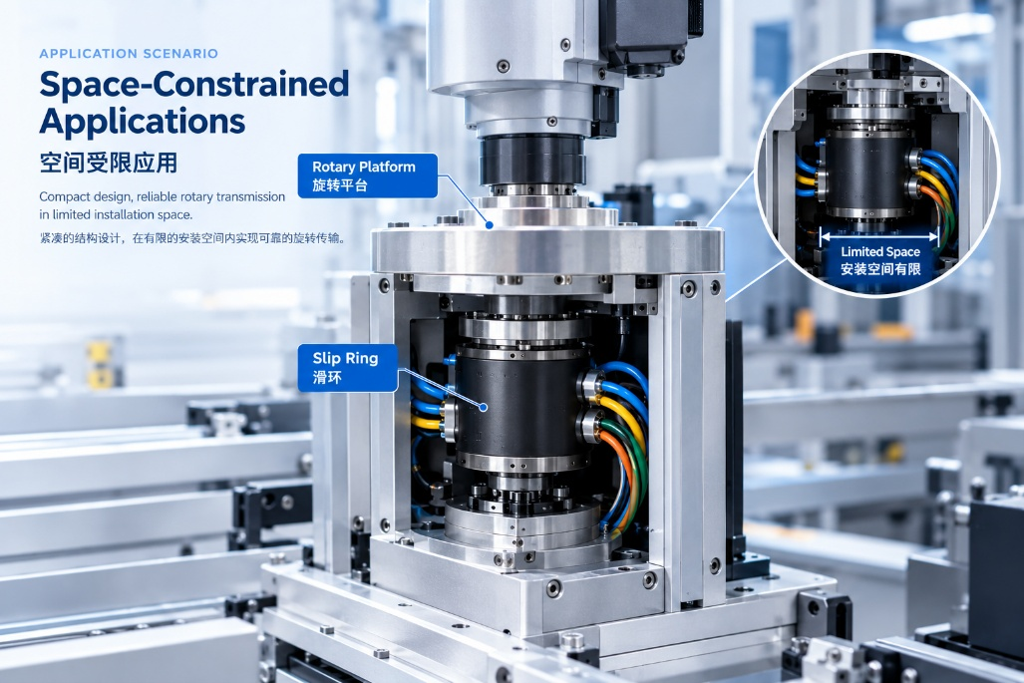
Common Scenarios for Space-Constrained Rotary Applications
Space limitations occur across various automated and industrial systems, each imposing specific physical restrictions:
Axially Restricted Environments: Equipment like low-profile index tables and medical rotary stages have severe height constraints but allow larger radial diameters..
Radially Restricted Enclosures: Devices like robotic joints, pan-tilt heads, and small gimbals feature narrow cylindrical housings with limited outer diameters.
Integrated Structural Housings: Assemblies where the slip ring must be integrated directly into a hollow shaft or customer-designed chassis without an external enclosure.
Key Conditions Influencing Slip Ring Selection
When specifying a space-constrained application, evaluating the relationship between physical geometry and functional requirements is essential:
Evaluation Factor |
Key Considerations |
Technical Impact |
Dimensional Priority |
Height/axial vs. diameter/radial limits |
Determines whether to use a flat pancake design, a miniature capsule, or a compact through-bore ring. |
Structure & Enclosure |
Housed unit vs. unhoused components |
Unhoused (separated) components save maximum space but rely on customer structure for alignment and protection. |
Channel Density |
Power vs. signal/data channel count |
Unhoused (separated) components save maximum space but rely on customer structure for alignment and protection. |
Center Passage |
Solid shaft vs. hollow bore |
Through-bore requirements dictate minimum internal diameter, impacting total outer diameter. |
Information Required from Customers for Technical Evaluation
To help engineers evaluate space-constrained applications accurately, customers should prepare the following details prior to inquiry:
Physical Envelope Dimensions: Maximum allowable axial length/height, maximum allowable outer diameter, and inner bore diameter (if passing shafts/cables/air lines).
Electrical & Signal Requirements: Total number of circuits, current and voltage per circuit, and specific data/bus protocol types (e.g., RS485, Industrial Ethernet).
Operational Parameters: Continuous or intermittent rotational speed (RPM), rotation direction, and duty cycle.
Environmental Conditions: Operating temperature range, required IP protection rating (e.g., IP54/IP65), and dust/vibration exposure.
Mechanical Interfaces: Preferred mounting method, stator/rotor anti-rotation flange designs, lead wire orientation, and connector specifications.
Hiscience Product Series for Space-Constrained Applications
Hiscience provides versatile rotary joint configurations tailored to different space constraints. Explore specifications through:
View Industry Applications: Industrial Automation Application Center
View Product Portfolio: Industrial Slip Ring Product Catalog
Need help with a customized rotary solution for space-constrained applications?
To receive a technical assessment and a customized rotary solution for space-constrained applications, please provide the following information in advance:
Bore diameter + number of circuits + current + voltage + signal/data requirements + rotational speed + installation space + operating environment
These specifications provide the basic information needed to evaluate a suitable slip ring configuration.
Contact Hiscience for slip ring solution tailored to your application.
Tel:+86-13543318795
+86-0755-23200548
Email:sales@hslipring.com
WhatsApp:+8613543318795
WeChat:13543318795
Address:3rd Floor, Building 1, Hengchangrong High-tech Industrial Park, No.128 Shangnan East Road, Shajing Subdistrict, Bao'an District, Shenzhen City