选择语言

Choosing a through-bore slip ring starts with understanding the mechanical and transmission requirements of your rotating equipment. The key factors include bore diameter, circuit requirements, current and voltage, signal or data transmission, rotational speed, installation space, and operating environment. Defining these requirements first helps determine a suitable slip ring configuration.
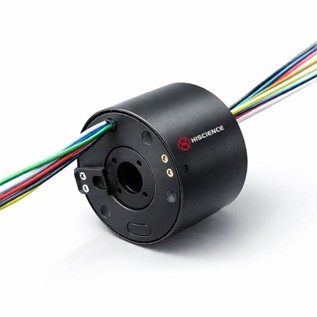
When Do You Need a Through-Bore Slip Ring?
A through-bore slip ring can be considered when a rotating part of equipment needs to continuously transmit power, signals, or data while allowing a shaft, cable, or pneumatic line to pass through the center.
Hiscience describes through-bore slip rings as products with a central hole for passing shafts, cables, or pneumatic lines, and lists applications including industrial automation, rotating platforms, radar systems, and packaging machinery.
What Factors Affect Selection?
1. Bore Diameter
First, confirm the shaft diameter and the required clearance. The available installation space and mounting structure should also be considered.
2. Electrical Requirements
Confirm the required:
Number of circuits
Current
Voltage
Power transmission requirements
Different configurations may be required for different electrical loads.
3. Signal and Data Requirements
If the equipment also needs signal or data transmission, specify the required transmission type, such as control signals, sensor signals, Ethernet, RF, or fiber optic transmission.
4. Speed and Environment
The required rotational speed and operating environment should also be considered. Provide information such as:
Rotational speed
Continuous or intermittent rotation
Temperature
Humidity
Dust or vibration
What Information Should Customers Provide?
To select a suitable through-bore slip ring more efficiently, customers should provide the following information:
Category |
Required Information |
Mechanical |
Bore diameter |
Available outer diameter | |
Available axial space | |
Mounting method | |
Electrical |
Current |
Voltage | |
Number of circuits | |
Signal / Data |
Signal type |
Data transmission requirements | |
Motion |
Rotational speed |
Continuous or intermittent rotation | |
Environment |
Operating temperature |
Humidity / dust / moisture | |
Connection |
Connector requirements |
Special Requirements |
RF, fiber optic, pneumatic, hydraulic, sensor, encoder, or other integration requirements |
If the application has special mechanical or transmission requirements, a mechanical drawing, wiring diagram, or application description can help with technical evaluation.
Hiscience Through-Bore Slip Ring Solutions
Hiscience provides through-bore slip ring solutions for rotating applications requiring continuous transmission of power, signals, or data.
The Industrial Slip Ring Series includes Through Bore Slip Rings, Pancake Slip Rings, Separated Slip Rings, and Bus Slip Rings.
For applications requiring additional transmission functions, customized solutions may integrate electrical power, signals, Industrial Ethernet, fiber optic signals, pneumatic channels, or hydraulic transmission.
Need Help Choosing a Through-Bore Slip Ring?
If you are not sure which configuration is suitable, provide:
Bore diameter + number of circuits + current + voltage + signal/data requirements + rotational speed + installation space + operating environment
These specifications provide the basic information needed to evaluate a suitable slip ring configuration.
Contact Hiscience for a through-bore slip ring solution tailored to your application.
Tel:+86-13543318795
+86-0755-23200548
+85-263174136
Email:sales@hslipring.com
WhatsApp:+8613543318795
WeChat:13543318795
Address:3rd Floor, Building 1, Hengchangrong High-tech Industrial Park, No.128 Shangnan East Road, Shajing Subdistrict, Bao'an District, Shenzhen City