选择语言

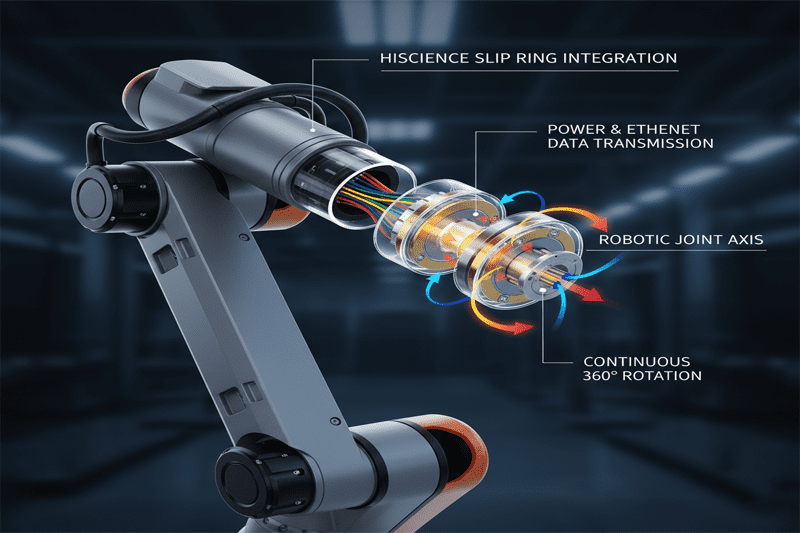
Industrial automation has become a key driver of modern manufacturing. From automated assembly lines to intelligent robotic systems, factories increasingly rely on advanced technologies to improve productivity, precision, and operational efficiency. In many of these systems, rotating machinery plays an essential role. Equipment such as robotic joints, rotary platforms, automated inspection devices, and packaging machines all require continuous rotation while maintaining stable transmission of power and signals.
One of the biggest challenges in rotating automation equipment is the transmission of electrical power and control signals between stationary and moving parts. Traditional cable connections can easily become twisted, worn, or damaged when exposed to continuous rotation. This can lead to unexpected downtime, reduced productivity, and higher maintenance costs.
Slip rings provide a reliable solution to this challenge. A slip ring is an electromechanical device designed to transmit electrical power, signals, or data between stationary and rotating components. By allowing continuous rotation without cable entanglement, slip rings ensure that automated equipment can operate smoothly and efficiently.
Hiscience slip rings are widely used in industrial automation systems due to their stable performance, compact structure, and high reliability. They enable automation equipment to operate continuously while maintaining stable electrical connections. In many automated systems, slip rings are integrated into rotating joints, indexing tables, or rotating platforms where power and signals must be transmitted without interruption.
In robotic automation systems, slip rings allow robotic arms to perform complex rotational movements while transmitting power to motors and signals to sensors and control systems. In automated production lines, slip rings support the operation of rotating assembly equipment and transfer systems. These applications require highly reliable electrical transmission to ensure precise movement and accurate control.
Another important advantage of Hiscience slip rings is their ability to transmit multiple signal types simultaneously. Many automation systems require hybrid transmission of power circuits, control signals, communication signals, and sometimes high-speed data. Hiscience slip rings are engineered to support these complex requirements while maintaining stable performance and low electrical noise.
In addition, Hiscience provides customized slip ring solutions to meet the specific needs of different automation systems. Depending on the application requirements, slip rings can be designed to support high current transmission, compact installation spaces, or integration with fiber optic and pneumatic channels.
As industrial automation continues to evolve toward smart factories and Industry 4.0 systems, the demand for reliable rotary transmission solutions will continue to grow. Hiscience slip rings play an important role in supporting modern automation equipment by enabling stable electrical transmission in rotating environments.
By combining advanced engineering design with high-quality materials, Hiscience slip rings help manufacturers build more reliable automation systems, improve production efficiency, and reduce maintenance costs.